
How much weight can a screw eye hold?
Short answer: a nickel-plated screw eye from a hardware kit holds a picture, a plant or a string of lights in solid wood, and it is not rated for lifting anything. The long answer is about the wood, the thread engagement and the direction of the pull, and about the difference between a screw eye and a forged eye bolt with a stamped working load limit.
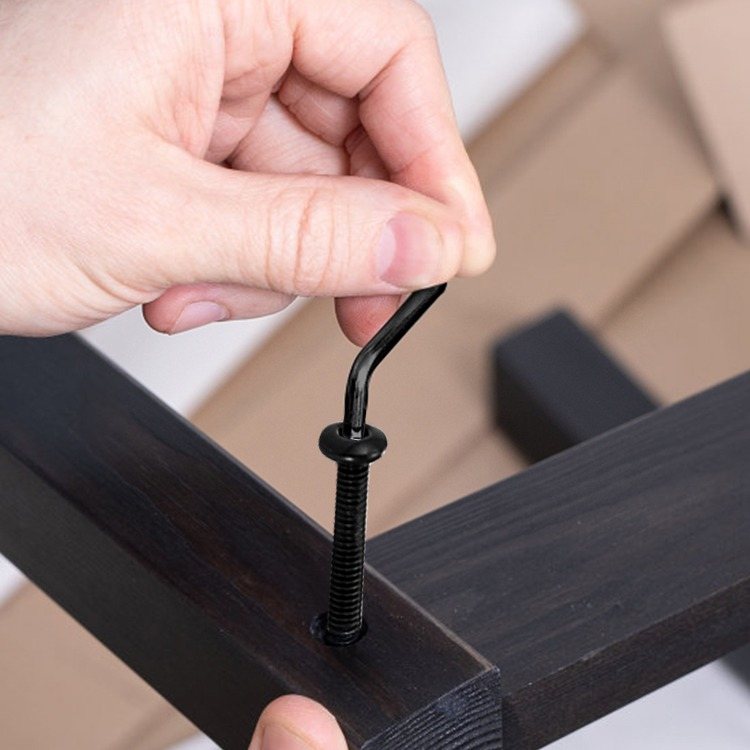
Screw eye or eye bolt: two different parts
A screw eye has a wood-screw thread and a bent-wire eye; it is driven by hand into wood. A forged eye bolt has a machine thread, a shoulder and a working load limit (WLL) marked by the manufacturer, installed through the material with a nut and washer; it is the only one of the two designed for hoisting, rigging or lifting equipment. The eye bolts in a rigging chart carry hundreds or thousands of pounds in a straight vertical lift: a 1/4-inch forged shoulder eye bolt is typically rated around 650 lbs straight, a 3/8-inch around 1,550 lbs, a 1/2-inch around 2,600 lbs. The eye on a screw eye is bent, not forged, and opens under a fraction of that. Nothing in our kit is lifting hardware, and no screw eye must ever be used to lift a load over a person.
What decides the hold in wood
Three things: the wood, the length of thread in it, and the diameter. A #10 screw eye with 1.5 inches of thread in a dry oak stud holds far more than a #4 in pine, and both hold almost nothing in drywall or particle board without an anchor. Thread engagement matters more than the eye itself: the screw eye should be properly seated with every thread in solid wood, which is why a pilot hole in hardwood is worth the extra minute. Steel quality matters less than the wood, because the wood fibres give up first.
Straight pull versus angular load
A pull in line with the shank, straight out of the wood, is the weakest direction for any wood screw. A load hanging down across the shank, as with a picture wire on a wall or a light string along a beam, is far stronger because the wood carries the shear. Rigging charts reduce an eye bolt's capacity sharply for angular loading: a plain-pattern eye bolt is for straight pulls only, a shoulder eye bolt keeps a share of its rating at 45 degrees, and a swivel hoist ring is what riggers use when the angle changes. The same logic applies to a screw eye on a shelf or a swing hook, so set the eye so the load hangs across it, not away from it.
Practical limits for the sizes in our kit
These are working figures for a screw eye seated fully in dry softwood, not ratings, and they assume the load hangs across the shank:
- #1 to #3 (0.75 to 0.9 inch): ornaments, small frames, craft, up to about 1 lb.
- #4 and #5 (1 to 1.1 inch): medium frames, mirrors, pegboards, a few pounds.
- #6 and #8 (1.18 to 1.37 inch): heavier frames, hanging baskets, gate latches, around 10 lbs in solid wood.
- #10 (1.75 inch): Christmas tree stand lines, outdoor light runs, 15 to 20 lbs in a stud.
Halve those expectations for a pull straight out of the wood, and use a proper anchor in anything that is not solid wood. Apply the same safety factor riggers use: if a hook will carry ten pounds, size it as if for twenty.
When to use something else
For anything that lifts, swings, or carries a person or machinery, use a forged shoulder eye bolt or a hoist ring with a stamped working load limit, installed through the material with a nut and washer, loaded within the angle the manufacturer allows, and inspected regularly for bending or thread damage. For a wall that is not solid wood, use a toggle or a screw anchor rated for the load. For a porch swing or a hammock, use a lag eye bolt into a joist, not a screw eye.
Installing a screw eye properly
Mark the spot, drill a pilot in hardwood (about the core diameter of the thread), start the eye by hand, then use a nail or a screwdriver through the eye as a lever to drive it until the thread is fully buried. The eye should sit tight against the surface with no thread showing; a screw eye left half out bends at the base under load.
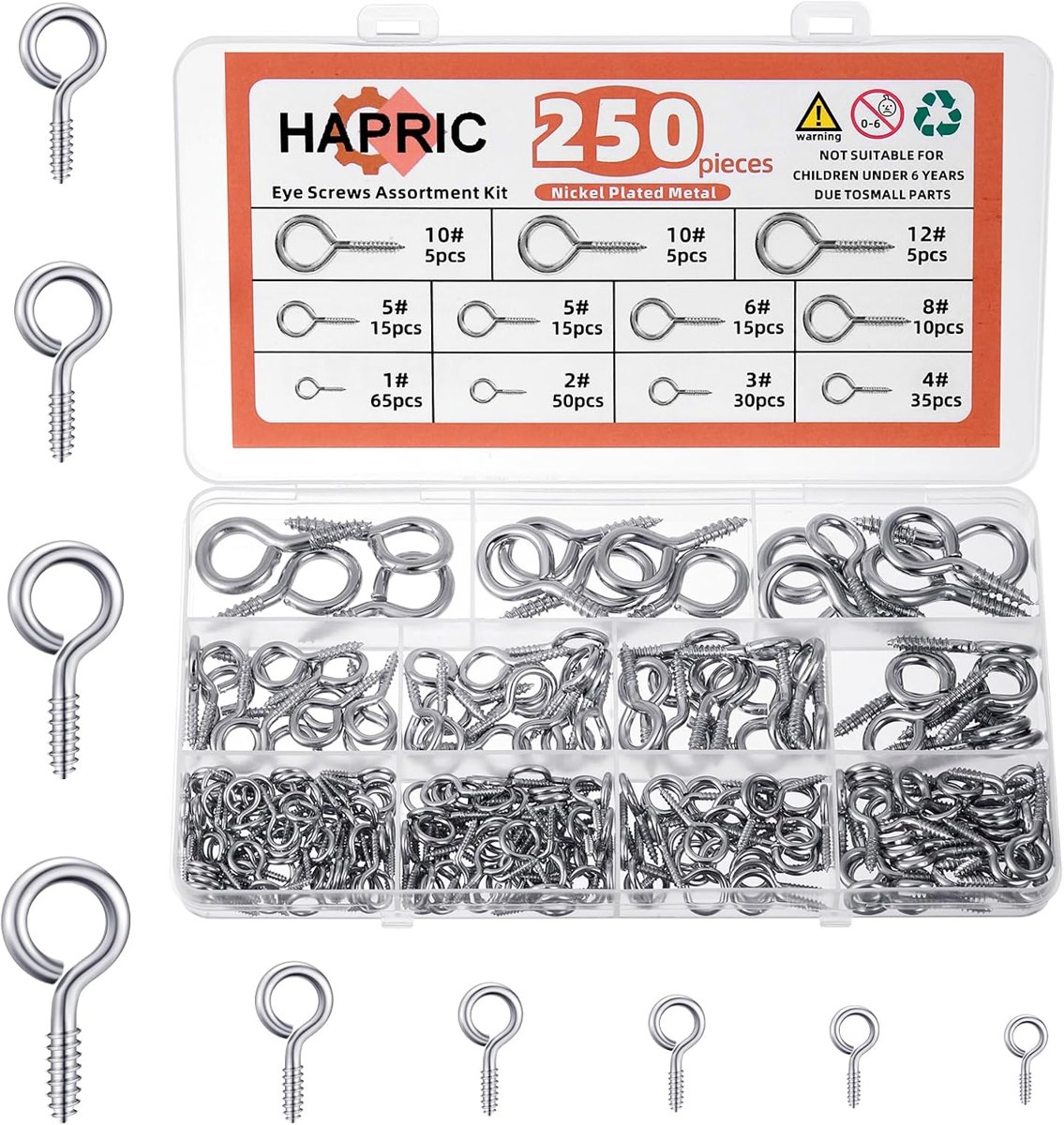
Sizes in the Hapric screw eye kit
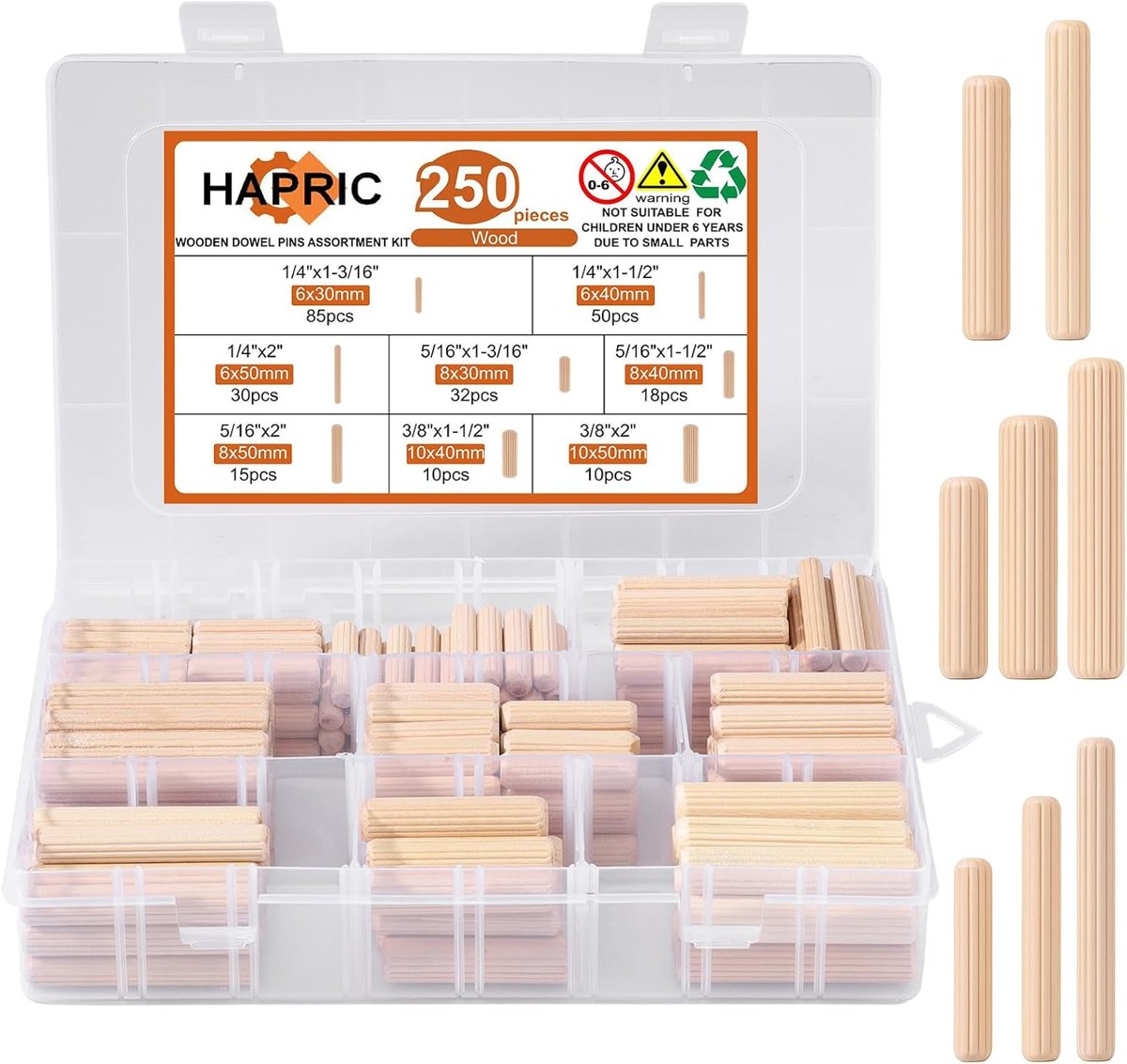
Nine sizes from #1 at 0.75 inch to #10 at 1.75 inch, nickel plated against rust, 250 pieces in a labeled divider case. They are the hooks for frames, wires, lights and latches, and the kit sits next to our dowel pins on the wood side of the drawer.